Welcome back to another segment of Movie Night Friday on The PBS Blog, where I list some of my favorite movies and why I love them.
This week, I’d like to discuss The Great Debaters.
I love this movie and I can give extensive reasons why but if I am honest, the real reason is poetry. I like The Great Debaters movie because their debates sound like spoken word poetry. Even before I knew Melvin Tolson was a poet, I found the language, even basic dialogue, so very poetic and the debates as Open Mic Nights.
Aside from this, there was also the concept of race in America and parenthood. Yes, parenthood. James Farmer Sr. was so engulfed in his work that he did not often give much attention to his son. For example, James Jr. was letting his father know, subtly, that he liked Samantha Booke, another fellow debater and classmate. He mentioned her as one of the alternatives among the group and, recognizing this, his father reminded him that “you must not take your eyes off the ball son.” While this was all good (as I loved the “we do what we have to do in order to do what we want to do” line) Farmer Sr. didn’t realize at that moment the opportunity to speak with his son about girls. It was this knowledge that upset his mom who didn’t say anything but whose anger could be seen in her sudden fast pace in peeling the potatoes. She recognized her husband’s failure to take this opportunity to have an intimate conversation with his son. This is the kind of writing that I love; the kind that could reveal an emotion or a feeling even without it being verbalized.
The Great Debaters is a movie based on real events about the poet and professor Melvin B. Tolson (Denzel Washington) who teaches at the predominately black Wiley College in Marshall Texas, in 1935. Tolson starts a debate team and as the tryouts begin and end, Tolson picks four students, three of which become the central focus of the movie. As the students prepare to challenge various schools, we see also how they deal with the challenges that face them in the Jim Crow south.
While at first Tolson butts head with the influential father (Forest Whitaker) of one of his best debaters, eventually Tolson is able to form a team of strong-minded, intelligent young students, and they become the first black debate team to challenge Harvard’s prestigious debate champions.
“Who’s the judge?”
“The judge is God.”
“Why is he God?”
“Because he decides who wins or loses, not my opponent.”
One of my favorite lines is this one. While I believe in calling the father by his name, Yah, I understand what this scene means and I like it because it’s strengthening even for those of us who are watching the movie. No matter who you think you are against, the judge is always Yah, not your opponent. In the end, we will be asked about our own sins and not the sins of others.
Tolson’s political views, add more to the story. He is a man who sneaks out at night to a country barn wearing overalls and works boots. And as rumors of radical communism sparks, it causes him to lose one of his students. Tolson is not to be undone, however, and keeps his politics out of the classroom. While the movie highlights his knowledge of poetry as he teaches English, it does not mention that he is a leading poet. Tolson in fact, published long poems in such magazines as the Atlantic Monthly and in 1947 was named poet laureate of Liberia.
History
As stated, this movie is based on the real-life events of the student debate team of Wiley College. Under the leadership of Tolson, Wiley College’s debate team became legendary. It won almost every debate among historically-black colleges and became the first to debate a white college when it took on and defeated Oklahoma City College in 1932. The team’s crowning achievement, however, came in 1935 when it defeated that year’s national champions, the University of Southern California. And naturally, after the movie was made in 2007, Wiley College rose to popularity again with increased enrollment and the re-establishing of its debate team.
My Favorite Line:
“I am here to help you to find, take back, and keep your righteous mind because obviously you have lost it.”
Trailer:
Funny Movie Mistakes:
It was hard to find any real mistakes in this movie. Most people say it is the Willie Lynch Speech, that there was no such letter and Tolson’s reciting of this piece of History is flawed. However, I do not believe that. I believe The Willie Lynch Letter did exist because I don’t believe in coincidences. Everything written in that letter to other slave owners on how to control their slaves can be seen in the behavior of many in the black community today. From the separation of the races by color (pitch the dark skin slave against the light skin slave), to the Making of a Slave and the Breaking process of the Black woman.
Welcome back to another week of Movie Night Friday, where I present some of my favorite movies and why I love them. Next up on our list is Malcolm X:
I still don’t understand why Denzel Washington could win an Oscar for Training Day and not Malcolm X, it is in my opinion one of his best roles (Washington did win the New York Film Critics Circle Award for Best Actor and was nominated for an Academy Award for Best Actor). Directed and co-written by Spike Lee, Malcolm X released in November of ’92 and is based on the life of Malcolm X from his Biography. It was a time where, after the crack epidemic of the 80’s, Black people had begun to pick up some inkling of consciousness. You’ll notice many movies in the early 90s where blacks wore Kufi’s, and Dashiki’s as an indication of awareness (even though not completely, there is always stepping stones that take place in our lives that start us on the right path). Needless to say Malcolm X was a hit.
The movie takes us through the life of Malcolm Little, his early life as a gangster and as a criminal and his transformation as the controversial Islamic, Black Nationalist leader Malcolm X. For the record, I am not a Muslim, but I love how Denzel showed Malcolm’s passion and anyone with access to YouTube can verify this in the eyes of the real Malcolm. It’s one thing to make a speech or stand for something, but it’s a completely different thing when you are sincere about it, when you have passion that comes from the depths of your very heart and Malcolm had this. He had this and it lit a fire under those who wished to be apart of change for the so called Black people. And because of the traumatic experiences of America, we more than our brothers and sisters in any other country worldwide, need the kind of discipline that Malcolm brought forward; a tough love if you will. I also love the outreach programs catered to the community and the re-instilling of a love of self; the teaching of black people to embrace, as Malcolm put it, “their beautiful black selves”. Of course today I have a different perspective on the whole black thing (as I do not believe our nationality is defined by a color, that we are from the lost tribe of shabbaz or that white people are devils, for the record), but this movie was a great first step for many young people, such as myself, to dig deeper into the question of nationhood. The movie even portrayed Malcolm’s awareness that the Hebrews, was (are) Black Skinned:
Yea Yea, ignore the title of the video because this isn’t about religion and it’s deeper than color, but the point is that scenes such as this is a great introduction to full understanding for someone who otherwise does not know.
Moving on…
Additionally, I loved the way Malcolm explained things because not everyone can do that. Yes, you say that you believe in something but what is that belief based on? And what do you mean? Malcolm spoke to understanding, he was precise, knowledgeable, and aware on a level that made your head spin. Just watching this movie alone makes me excited and compelled to do something. But of all this, the most important part of the movie, in which it was careful not to go into much detail, was the end, Malcolm’s split from the NOI (Nation of Islam)
You see, I cannot judge neither Malcolm X or Martin Luther King Dr., for what they were for the first part of their lives. For me, what’s important is how they ended their lives. Malcolm X left this world with a different outlook on life and I do believe he understood the truth completely. He discovered the lies and attempted to expose the truth when he was murdered, as did Dr. King (whose entire jaw was blown off as symbolism that you keep your mouth shut). You see, men of this caliber, who spark this much power among black people, they aren’t just killed by random acts of violence, they are murdered and this is not political mumbo jumbo nor is it conspiracy theory; this is conspiracy fact.
In 2010, Malcolm X the film, was selected for preservation in the United States National Film Registry by the Library of Congress as being “culturally, historically, or aesthetically significant”.
Trailer:
Funny Movie Mistakes:
When Malcolm is talking on the telephone in an extreme close up, you can see the connector on the phone is one of the modern snap-in modular jacks. Telephones in the 1960’s did not have those.
It is a treasure to find movies that have it all, and Coming to America is one of those movies. Comedy, History, and Symbolism.
For the most part, I fell in love with this movie for the same reason that everyone else did, because of its humor. If you need something to help make you laugh then put this movie in. I’m not even going to ask you if it’s part of your collection. I mean, you do have Coming to America…..right???? But as time went on I also started to notice other information of importance that surpassed the laughs. Not only is this movie extremely hilarious, but it also includes many messages.
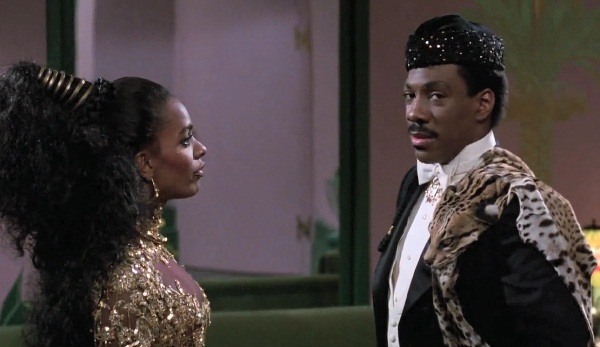
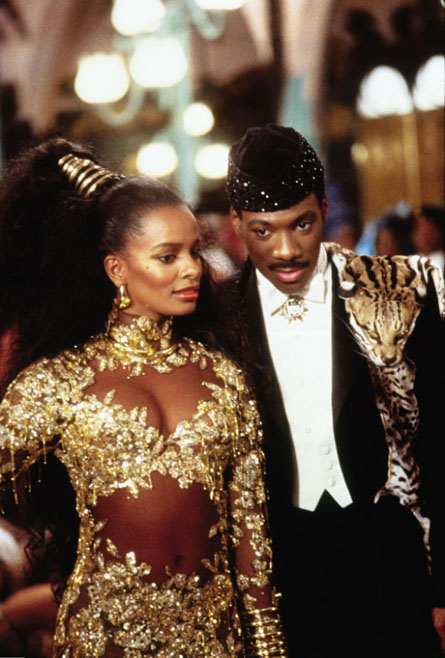
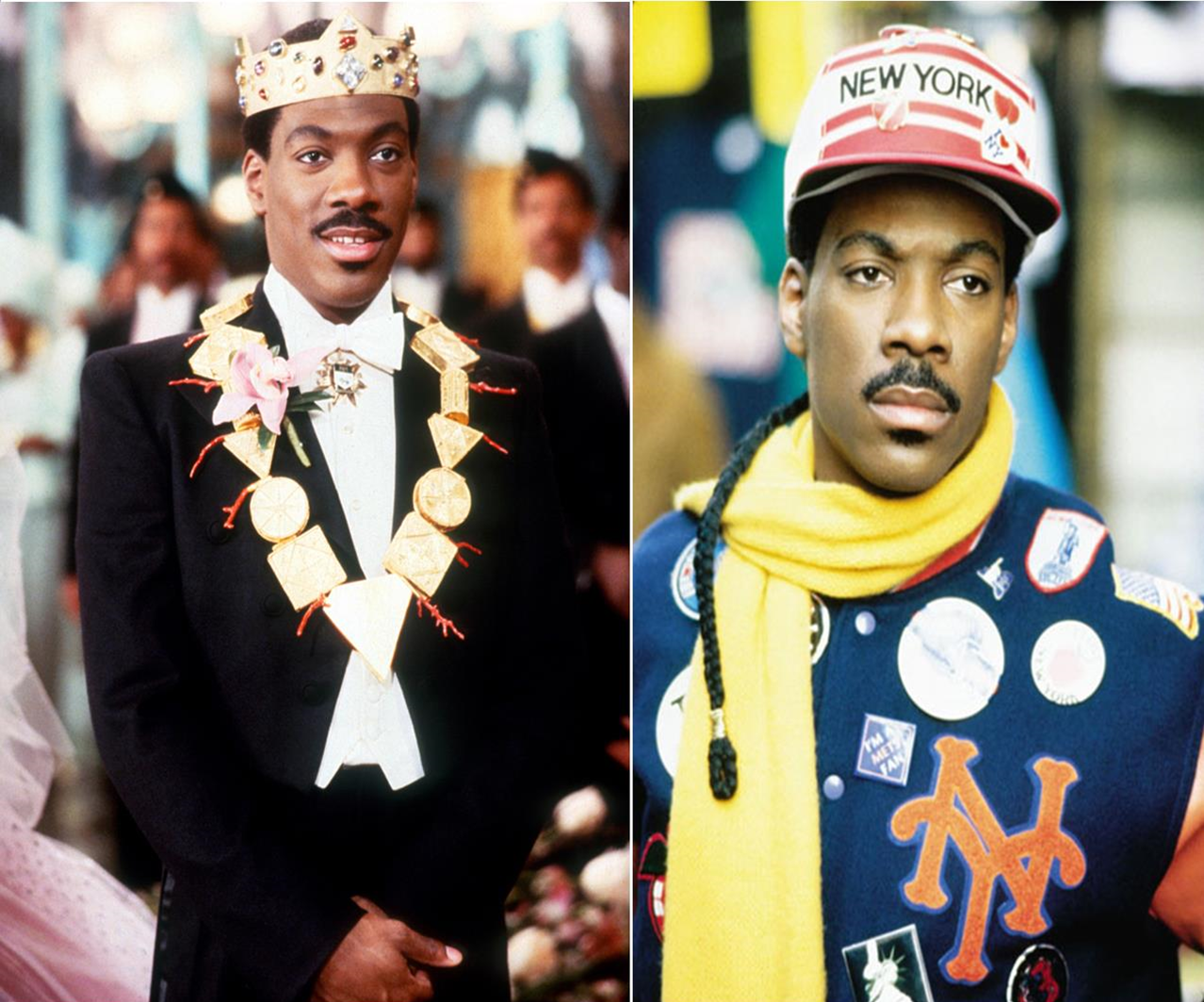
Starring Eddie Murphy and Arsenio Hall, Coming to America is about Akeem Joffer, the crown prince to the throne of the wealthy African nation of Zamunda, who lives a prosperous life. But having been appointed a wife from birth and forced to marry her, Akeem is unfulfilled to take a woman who would obey him and submit to him. He is also uneasy with the idea of the arranged marriage. In fact, he is sick of being pampered in general. As a result, he decides to take a trip to America to find his bride; as he puts it, “someone who will excite his intellect, as well as his loins.” To make a long story short, he takes with him his friend (or personal side kick whichever fits), named Semmi and together they end up in Queens New York, an impoverished part of New York City, and opt to stay in a run-down apartment in one of the most disgusting rooms in the building (“it’s a shame what they did to that dog”…lol)
Now, since there is so much here, I’m going to take only a couple aspects of the movie that I see that involve a deeper message than the ability to tickle the funny bone.
#1: Authority and Submission
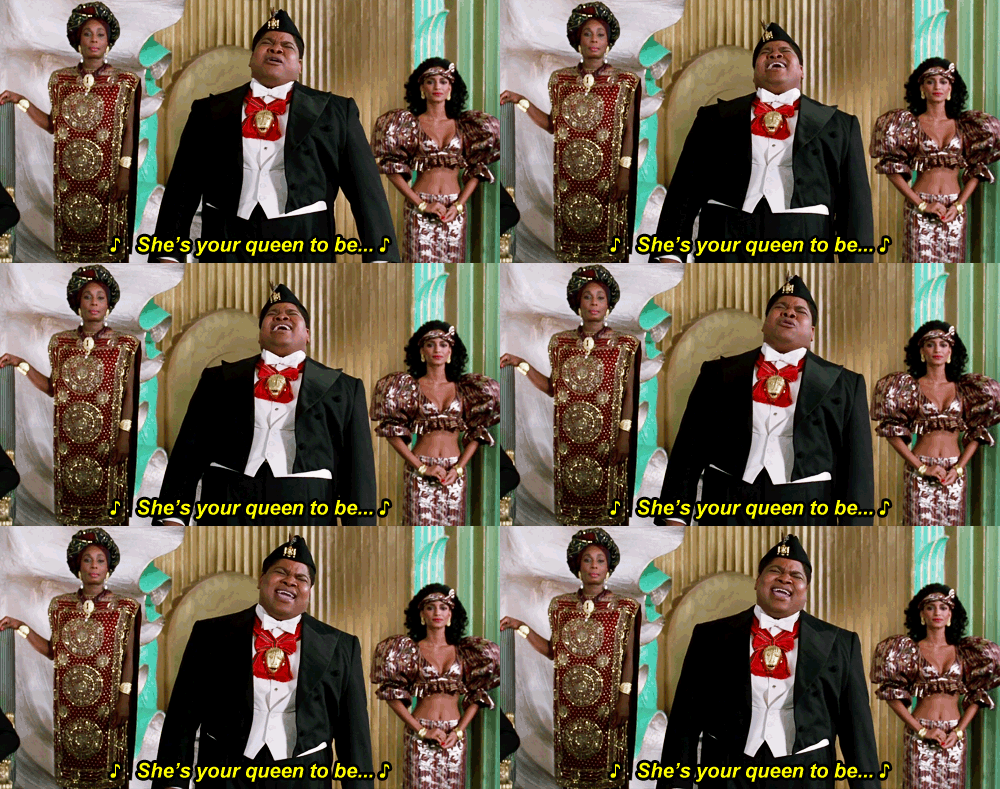
To start, part of Akeem’s travels is that he is not interested in taking a submissive woman as wife. It’s more than the arranged marriage; it is also the woman’s trained obedience to his authority. The famous, “Whatever you like…” scene showcases this well. While many of us laughed at this and threw our “I know that’s rights!” into the air, smashing our judgmental comments of Imani Izzi (arranged bride-to-be seen here) at the screen, in truth there was nothing wrong with what she said. Of course they had to exaggerate it, but the point is that a woman is supposed to obey her husband. She is his helpmate and her desire is his desire. Contrary to popular belief, authority has nothing to do with money. A man is not the head of his household because he’s supposed to make the money and a woman’s money does not appoint her as the head either. This is society’s definition of authority and it is the reason many women think they can step all over a man because they make more money than he does. And isn’t it a shame? That the one thing we value most in a man, many of our men do not have. No wonder 70% of black women are single.
A man’s authority is to be the leader and the protector of the family. A man provides more than just money. He provides protection, leadership, and guidance just to name a few. Contrary to feminist thought, submission does not mean weak nor is it synonymous with slave. Submission just means to give respect and to be in agreement. When a woman is respectful and in agreement with her husband she is following his direction. In addition, she strives to keep him happy in every aspect. The saying that a woman is a lady in public and a freak in the bedroom is not made up by happen chance. It just means that a woman works to keep her man happy in every capacity. Even something as subtle as King Jaffe sitting on the throne and Queen Aeoleon standing by his side; this is an accurate portrayal of how it should be. It is no wonder the King walks around with a lion hanging from his shoulders. In the animal kingdom, the lioness hunts down the food, she brings it to the lion, and he is the first to eat. Like I said, respect. As you can see from this example, the woman is by no means idle and her job is not insignificant. She must work to keep the family strong just as he does and ensure her home is a happy and thriving one for her family. She may do this by working or staying at home. Either way, she is helping to add to the strength of this business of sorts called family. She makes decisions and suggestions as well but this authority does not surpass that of her man’s. There can be only one CEO of this business and he stands up to pee for a reason.
In short, Akeem refuses a woman from his own cultural background who will be obedient and respectful to him, and instead seeks a woman from America who is more independent-minded.
#2 Identity
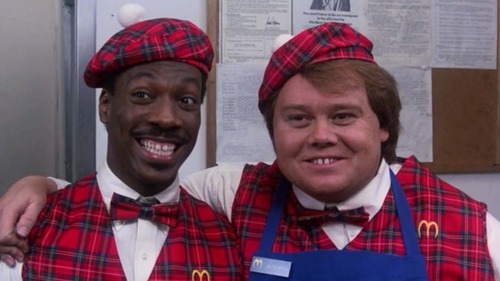
Akeem is in line to receive his father’s possessions. He is the royal descendent of a great people, much like the children of Israel. As he and Semmi maneuver their way around the “Land of the Free”, you start to notice an unraveling of their culture. They do not desire to be a set-apart nation of priests; they are simply, “Ordinary Americans.” They go from living in a palace to living in poverty; from letting their hair grow long to cutting it off; to being draped in gold, to designer jackets; from being pampered and provided for by a King, to having to work a 9-5 at a restaurant. Akeem and Semmi go from being among a powerful and set-apart people, to a downtrodden and despised people. They go from being in line to inherit the blessings, to accepting of the curse. In America, Akeem is not proud of his cultural heritage, he is ashamed of it.
Even the end of the movie is significant, but I will leave that part alone for the 2-3 people reading this who have not seen Coming to America (smh).
Trailer:
Funny Movie Mistakes:
When Akeem and Semmi get their apartment, the landlord says that the room has only one window facing a brick wall. But when Akeem is out on the fire escape, he yells out to a street, not a wall. And there are two windows.
Watch the movie and see if you can spot the knot!
“What’s your favorite movie? Is this among your collection? Why do you love it?”
Good Morning everyone and welcome to another week of Movie Night Friday. Where I present some of my favorite movies and why I love them.
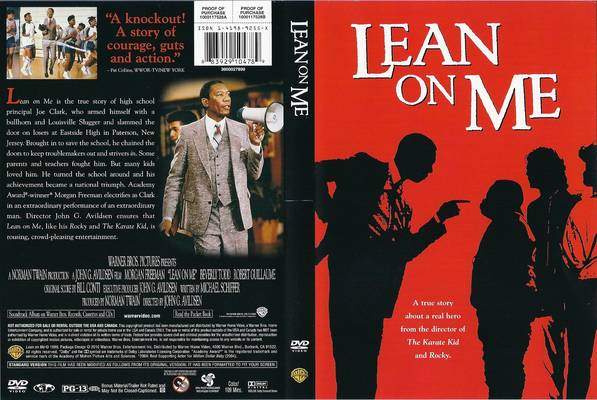
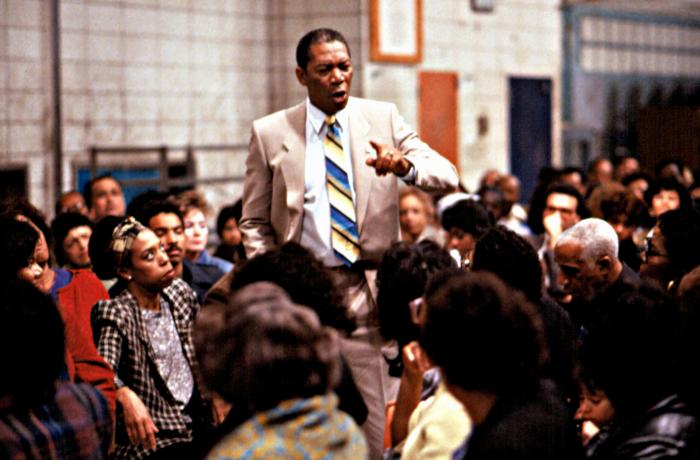
“Lean on Me” is one of my most favorite movies. In fact, as I think about it, this one should have been first! Then again, I’ll probably say the same thing about next week’s pick. This is after all my most favorite movie list.
“Lean on me” (’89) is a movie based on the real life story of a New Jersey High School principle, Joe Clark, who was called in to be principle of East Side High School. A former teacher of the school back in the 60s, the place to which he returns is anything but the way he left it. It is no longer a place of learning, but a place of drug abuse, gang violence, and despair. The premise of Clark’s return is built on the coming closure of the school. If Clark cannot get the children to pass the minimum Basic Skills Test, the school will close.
What I like about the movie is the dramatization of someone who truly cares about his students and their well-being. Joe Clark is a principle, a teacher, and also a father. I also like Clark’s no non sense demeanor. When he steps into the school to find it in such chaos, he focuses his attention on the teachers. He scolds them for their lack of authority and effort in maintaining the school. He does not accept their excuses, nor does he accept their advice; for if they had done it right the first time, he would not be there. His methods are strict yes, and he is in many areas arrogant and in need of a little scolding himself, however, his stern approach is exactly what the school needs. Why is the music teacher preparing her students to perform Mozart at a concert when they can barely read? The school is overrun by students who’ve been there over five years and have no intention of getting an education. As a result, those trouble-makers are thrown out and everyone, from student, to parent, to teacher, to Vice Principle, is held strictly accountable for their actions. Even the school board feels Joe’s rage.
LEAN ON ME, Morgan Freeman, Lynne Thigpen, and cast, 1989.
But eventually, his unconventional methods lead to a clash with city officials and outraged parents of students who’ve been expelled. One parent in particular is out for Clark’s blood. If only she can be added to the school board to vote Clark out. And when Clark puts chains on the school doors to keep the gang members out, the Fire Marshall warns about the fire hazard, though Clark dismisses his threats. But if the Fire Marshall catches Clark with the chains on the doors however, it won’t be good for him, his students, or the new school he is trying to build from what’s left of the rubble.
Movie Trailer:
Funny Movie Error:
When Joe Clark is having his talk with Sams on the edge of the roof of the school, Sams is on the right and Clark is on the left (when viewed from the ground). When they’re done talking, Sams turns to his left and walks away – turning to his left would have made him fall off the roof after just a few steps.
When I think of Friday nights, I think of rest; of sabbaths, relaxation, peacefulness, calm, repose; time-out. I also think of a good movie to watch. If possible, I would like to fill up my Friday posts (every now and again) with my favorite movies and why I love them. We’ll call this:
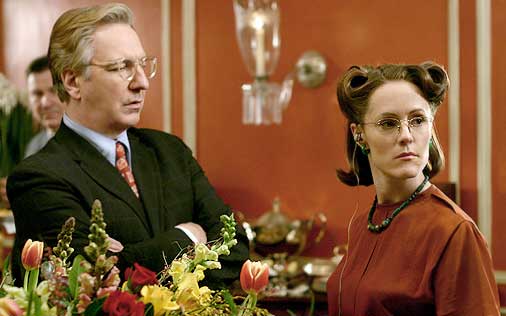
At the top of my list is one of my favorite movies called “Something The Lord Made”, starring Mos Def, Alan Rickman, and Gabrielle Union. A made for TV movie back in 2004 and based on a true story, Something The Lord Made is the story of Vivien Thomas, a black man who was not a doctor, not a college graduate, and paid a janitor’s wage and yet, became one of the most skilled surgeons of his time.
In 1930, Vivien Thomas (19) played by Mos Def, was a carpenter from Nashville with ambitions to attend Tennessee State College and then medical school. However, he was fired from his job and took a position as janitor at Vanderbilt University, as learned through a friend, working under Dr. Alfred Blalock, the world famous “Blue Baby” doctor who pioneered modern heart surgery, played by Alan Rickman. Vivien’s plans were to work temporarily as to save for college, but the depression wiped out his savings as well as his hope of going to school.
However, while hired as a janitor, Thomas quickly becomes a key component in Blalock’s medical research and becomes Blalock’s medical research partner. Vivien is not just any partner; Vivien is brilliant, using his carpentry skills, profound intellect, simplicity, and teachings from his father to learn in three weeks what most lab assistants learned in months. Blalock sees potential in Vivien and lets him in on his groundbreaking work on shock, the first phase of the body’s reaction to trauma. In short, Vivien became a cardiac pioneer 30 years before the first black surgical resident. And he was just a High School graduate.
The movie picks up when the men move their work to John Hopkins Hospital in 1941. Mary Masterson plays Helen Taussig, the pediatrician / cardiologist. At a social gathering among the doctors, at which Thomas is the waiter, Taussig challenges Blalock to come up with a surgical solution for her blue babies, babies who practically suffocate due to a blockage in the main artery in the lung, medically termed, Cyanosis ( the appearance of a blue or purple coloration of the skin or mucous membranes due to the tissues near the skin surface having low oxygen). She needs a new way for them to oxygenate the blood. The movie shows the two, Blalock and Thomas, in the lab conducting experiments and experimenting on dogs. Their plan is to figure out how to turn the dogs “blue” by giving them the blue baby condition and then figuring out a way to solve it.
The film dramatizes Blalock and Thomas fight to save the babies and Blalock praises Thomas surgical skill as being “like something the lord made”. But outside the lab, they are separated by the racism of the time. Thomas is a bartender, a waiter, and despite his genius in the lab—conducting most of the experiments, doing the research, and standing over Blalock’s shoulders to ensure the surgical procedures are done correctly—he is paid a janitor’s wage. He is not an invitee to the Belvedere Hotel where they honor those of the Blue Baby surgery, not featured in the magazines, and not given credit at all for his remarkable contribution to the medical field. In what way does Vivien become one of the most talented surgeons of time, training white surgeons with doctorate degrees, at an institution where he has to enter through the back door? How does the story unfold? Who was Vivien Thomas? This movie is a must see.
Trailer:
Spot the knot! (Funny Movie Mistakes)
When you watch this movie (Check Netflix ), when Clara (Thomas wife, played by Gabrielle Union), takes her seat next to Thomas on the bus and begins talking to Vivien, a modern SUV, sedan, and pickup truck are briefly visible in a parking lot behind them. Try to see if you can catch it!
I would like to present first Philips Wheatley because as I embark on publishing my third collection of poetry, I cannot help but wonder what it must have been like for her to be the first. Phillis Wheatley was the first black poet in America to publish a book. She was born on May 8, 1753 in West Africa and brought to New England in 1761, where John Wheatley of Boston purchased her as a gift for his wife. Like many of her time, Phillis was taught to read by her owners and could read and write English by the age of nine.
Many people are under the impression that slaves were of pure ignorance; that they muttered broken English because they were imbecile. This is not truth. Slaves were only ignorant so far as the English language is concerned, at which they could not read, write, and could barely speak. They were strangers in a foreign land and introduced to ways to which neither they nor their fathers had known. Put me in the middle of a street in China and see how dumb I will be.
Nonetheless, Wheatley also became familiar with Latin, Greek, the Bible, and selected classics at an early age. She began writing poetry at thirteen (around the same time I started writing), modeling her work on the English poets of the time, particularly John Milton, Thomas Gray, and Alexander Pope. Her poem “On the Death of the Rev. Mr. George Whitefield” was published as a broadside in cities such as Boston, New York, and Philadelphia and garnered Wheatley national acclaim. This poem was also printed in London.
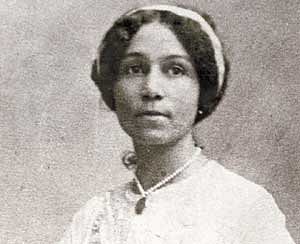
Anne Spencer
1882–1975
Anne has too many names for me to keep up with so we’ll stick with Anne Spencer. Anne was born in Virginia in 1882. She was the daughter of a former slave and her mother enrolled her in school for the first time when she was eleven years old. She graduated seven years later as valedictorian. Known as a “Harlem Renaissance Poet”, Anne was good friends with many Harlem Renaissance writers, including James Weldon Johnson, Langston Hughes, and W.E.B. Du Bois. Spencer’s poetry engages themes of religion, race, and the natural world. Thirty of her poems were published during her lifetime, in such anthologies as The Book of American Negro Poetry (1922) and Caroling Dusk (1927) and was the first African American woman poet to be featured in the Norton Anthology of Modern Poetry (1973).
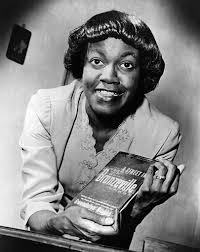
Gwendolyn Brooks
1917–2000
For some reason, whenever I say this woman’s name I think of Books. Seems like it should be Gwendolyn Books, but anyway, Brooks and I do actually have something in common: we are both from Chicago. Brooks was born in Topeka, Kansas, but her family moved to Chicago when she was young. Her father was a janitor who had hoped to become a doctor; her mother was a schoolteacher and trained pianist. They were supportive of their daughter’s passion for reading and writing. Brooks was thirteen (again around the same age I was when I began writing) when her first published poem, “Eventide,” appeared in American Childhood; by the time she was seventeen she was publishing poems frequently in the Chicago Defender, a newspaper serving Chicago’s black population. After such formative experiences as attending junior college and working for the NAACP, she developed her craft in poetry workshops and began writing the poems, focusing on urban blacks, that would be published in her first collection, “A Street in Bronzeville”.
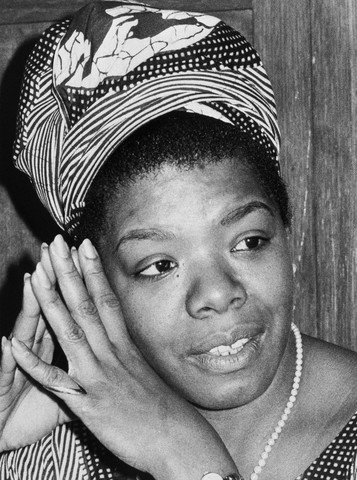
Maya Angelou
1928-2014
I could probably leave this part blank and many of you would still know who this woman was. The poet and award-winning author known for her acclaimed memoir “I Know Why the Caged Bird Sings” and her numerous poetry and essay collections. Born on April 4, 1928, in St. Louis, Missouri, writer and civil rights activist Maya Angelou is known for her 1969 memoir, I Know Why the Caged Bird Sings, which made literary history as the first nonfiction best-seller by an African-American woman. In 1971, Angelou published the Pulitzer Prize-nominated poetry collection “Just Give Me a Cool Drink of Water ‘Fore I Die”. She later wrote the poem “On the Pulse of Morning“—one of her most famous works—which she recited at Bill Clinton’s inauguration in 1993. Angelou received several honors throughout her career, including two NAACP Image Awards in the outstanding literary work (nonfiction) category, in 2005 and 2009. She died two days after my 27th birthday on May 28, 2014.
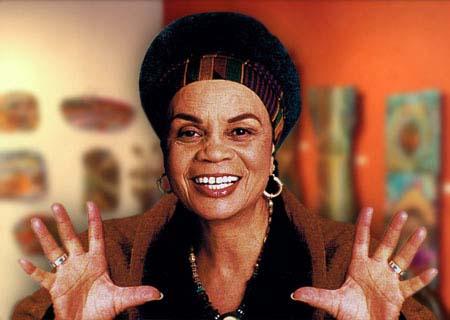
Sonia Sanchez
1934
Sonia is another poet whose name rings with such prominence that I could leave her bio blank too and many of you would still know who she is. Born Wilsonia Benita Driver, on September 9, 1934, in Birmingham, Alabama Sanchez lived with her paternal grandmother and other relatives for several years after her mother died in childbirth a year later. In 1943, she moved to Harlem with her sister to live with their father and his third wife. Sonia married and divorced Albert Sanchez, a Puerto Rican immigrant whose surname she kept.
In the 1950s, Sanchez formed a poets’ group, the Broadside Quartet. Sanchez began teaching in the San Francisco area in 1965 and was a pioneer in developing black studies courses at what is now San Francisco State University, where she was an instructor from 1968 to 1969. Sanchez is the author of more than a dozen books of poetry, including “Morning Haiku” (Beacon Press, 2010); “Shake Loose My Skin: New and Selected Poems” (Beacon Press, 1999); “Does your house have lions?” (Beacon Press, 1995), which was nominated for both the NAACP Image and National Book Critics Circle Award; “Homegirls & Handgrenades” (White Pine Press, 1984), which won an American Book Award from the Before Columbus Foundation. From the 1970s through the ’90s, she wrote poetry, plays and kids’ books. She retired from her Laura Carnell chair in English in 1999.
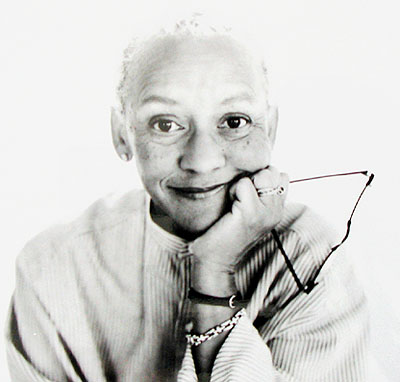
Nikki Giovanni
1943-
Giovanni’s collections, like the women before her, focused on African American identity. Born Yolanda Cornelia, Nikki Giovanni was born in Knoxville, Tennessee on June 7, 1943 and raised in Cincinnati Ohio, a place I got the chance to visit for our 8th Grade school trip. On July 28, 2000, when I was thirteen years old, I lost my Dad to cancer. In December of 2014, I lost my Aunt to the same disease. In some way or another I can sympathize with Giovanni, who is not only a poet but a Lung Cancer survivor and has contributed an introduction to the anthology Breaking the Silence: Inspirational Stories of Black Cancer Survivors (Hilton Publishing, 2005). Giovanni has been awarded The Langston Hughes award for Distinguished Contributions to Arts and Letters in 1996, as well as more than twenty honorary degrees from national colleges and universities. She has been given keys to more than a dozen cities, including New York, Los Angeles, Dallas, Miami, and New Orleans. She has served as poetry judge for the National Book Awards and was a finalist for a Grammy Award in the category of Spoken Word.
She is currently professor of English and Gloria D. Smith Professor of Black Studies at Virginia Tech, where she has taught since 1987.
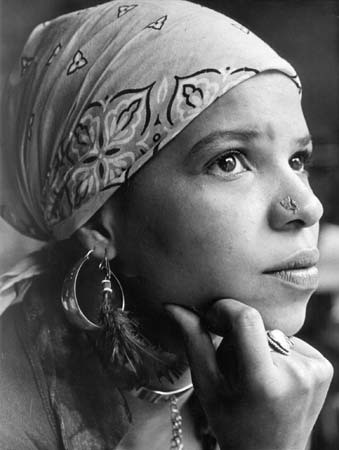
Ntozake Shange
1948-
I fell in love with Shange’s poems almost instantly. I really enjoy the raw truth of experience embodied in the words and the style in which they occupy the page is hard to ignore. I like how she allows the words to be written just how they are spoken, how they ignore the “professionalism” of the edit. (though poetry does tend to allow for this kind of freedom).
Born Paulette Williams, Ntozake Shange was born into an upper middle-class African-American family. Her father was an Air Force surgeon and her mother a psychiatric social worker. Cultural icons like Dizzie Gillepsie, Miles Davis and W.E.B. DuBois were regular guests in the Williams home. Shange attended Barnard College and UCLA, earning both a bachelors and master degree in American Studies. But Shange is most famous for her play For Colored Girls Who Have Considered Suicide/When the Rainbow Is Enuf (1975) which is how I was introduced to her. A unique blend of poetry, music, dance and drama called a “choreopoem,” it “took the theater world by storm” said Jacqueline Trescott in the Washington Post, as it “became an electrifying Broadway hit and provoked heated exchanges about the relationships between black men and women…Its form—seven women on the stage dramatizing poetry—was a refreshing slap at the traditional, one-two-three-act structures.” The play uses female dancers to dramatize poems that recall encounters with their classmates, lovers, rapists, and abortionists. The women survive abuse and disappointment and come to recognize in each other the promise of a better future.
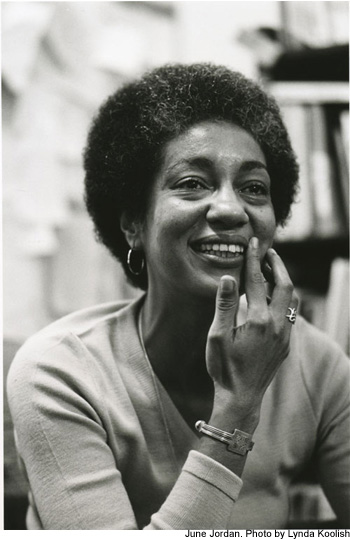
June Jordan
1936-2002
June Jordan is the author of children’s books, plays, a novel, and Poetry for the People: A Blueprint for the Revolution (1995), a guide to writing, teaching and publishing poetry. Her collections of political essays include Affirmative Acts: Political Essays (1998) and Technical Difficulties (1994). Basic Books published her memoir, Soldier: A Poet’s Childhood, in 2000.
Born in New York City on July 9, 1936, June Jordan attended Barnard College. She received the National Association of Black Journalists Award, and fellowships from the Massachusetts Council on the Arts, the National Endowment for the Arts, and the New York Foundation for the Arts.
Her numerous books of poetry include Directed by Desire: The Collected Poems (Copper Canyon Press, 2007), Haruko/Love Poems (1994), Passion (1980), and Things That I Do in the Dark (1977), among many others. She taught at the University of California, Berkeley, where she founded Poetry for the People. June Jordan died of breast cancer on June 14, 2002, in Berkeley, California.
Rita Dove
1952-
Rita Dove is the first African-American woman to be named Poet Laureate of the United States, and only the second to win a Pulitzer Prize for poetry (Thomas and Beulah, 1987), Rita Dove has achieved a great deal in her career. Her multi-layered poems dramatize the stories of individuals both living and dead against the backdrop of larger historical forces (I really like “Reverie in Open Air”). Rita was born in Akron, Ohio on August 28, 1952. Her books of poetry include (but are not limited to) Sonata Mulattica (W. W. Norton, 2009); American Smooth (W. W. Norton, 2004); On the Bus with Rosa Parks (W. W. Norton, 1999), which was named a New York Times Notable Book of the Year and was a finalist for the National Book Critics Circle Award. In addition to poetry, Dove has published a book of short stories, Fifth Sunday (University of Kentucky Press, 1985), the novel Through the Ivory Gate (Pantheon, 1992), essays in The Poet’s World and the verse drama The Darker Face of the Earth (Story Line Press, 1994). She also edited The Best American Poetry 2000 and The Penguin Anthology of Twentieth-Century American Poetry (Penguin, 2011).
Dove is Commonwealth Professor of English at the University of Virginia, where she has been teaching since 1989.
********************************************
And that’s it for this week’s episode of Black History Fun Facts. Don’t forget to check out last week’s episode, in case you missed it:
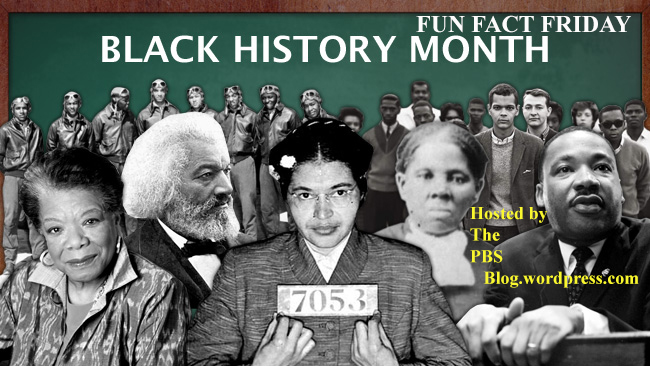
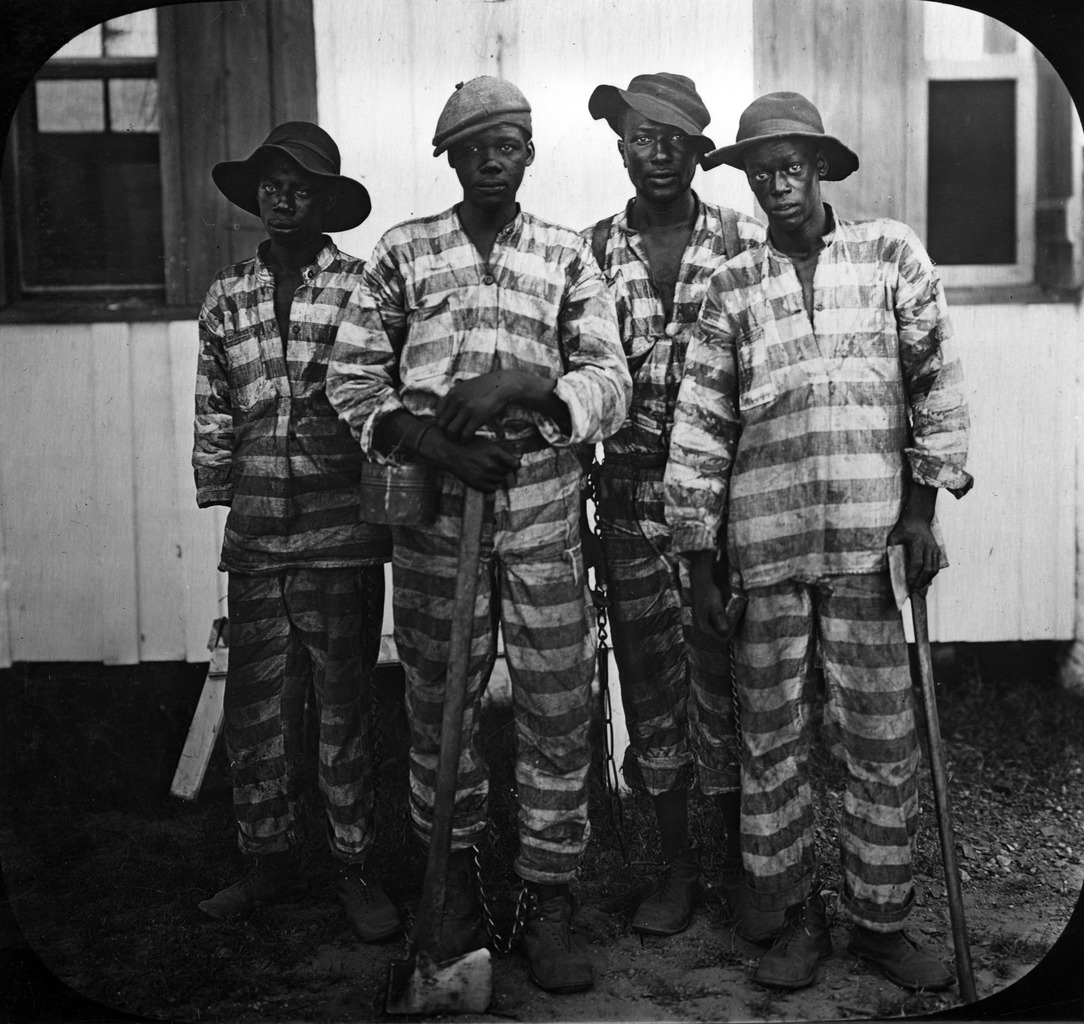
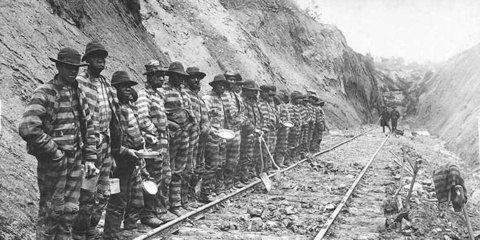
Welcome Back everyone to another episode of Black History Fun Fact Friday! Where we present movies, products, books, audio, or article Fun Facts on a portion of the History of African American people. We cover all things Archeological, Biblical, Historical, and most importantly, Factual. Today marks our 4th week into the series and we’d like to celebrate our month in with an excellent documentary on the history of convict leasing, but first, a little History:
According to the 13th Amendment: “Neither slavery nor involuntary servitude,
except as punishment for crime
whereof the party shall have been duly convicted, shall exist within the United States, nor any place subject to their jurisdiction.”
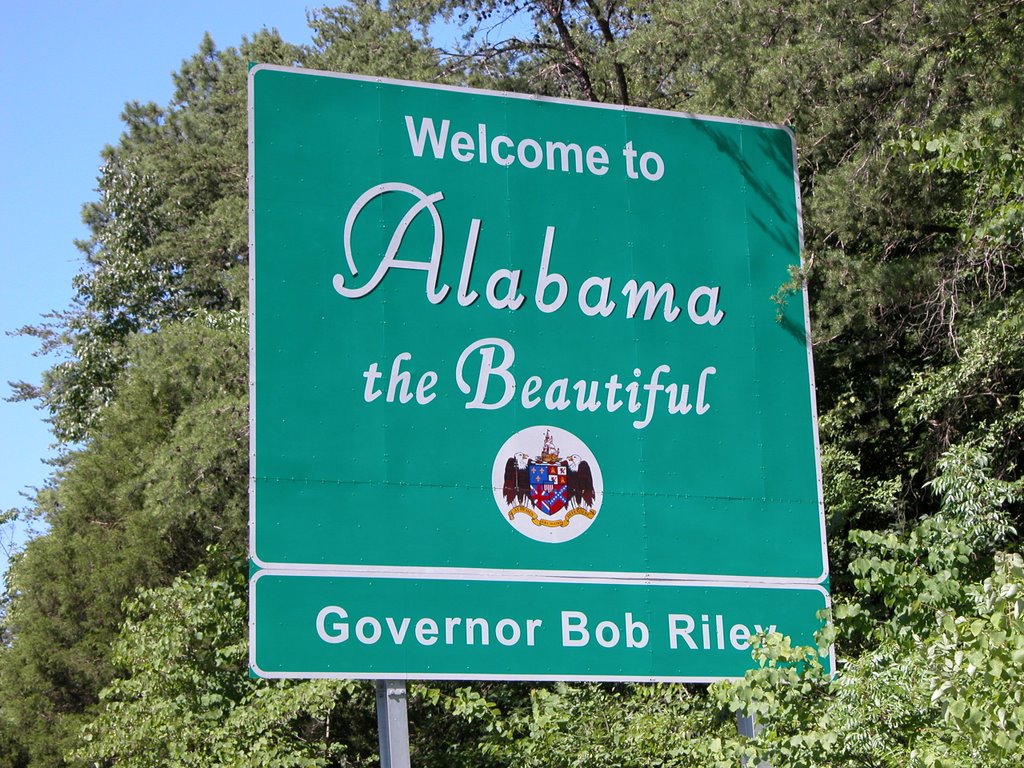
Convict leasing began in Alabama in 1846 and is recorded as lasting until July 1, 1928, however our past and present prison population speak a different language. Today, more than 60% of the people in prison are African American. For Black males in their thirties, 1 in every 10 is in prison or jail on any given day. Take a class filled with black boys and 1 in 3 has a likelihood of ending up in prison. It has gotten so bad that prisons now calculate the percentage of beds needed for cells based on whether or not black boys can read by the 4th grade.
In 1883, about 10 percent of Alabama’s total revenue was derived from convict leasing. In 1898, nearly 73 percent of total revenue came from this same source. Death rates among leased convicts were approximately 10 times higher than the death rates of prisoners in non-lease states. In 1873, for example, 25 percent of all black leased convicts died.
While most believe that the 13th Amendment abolished slavery and involuntary servitude, a loophole was opened that resulted in the widespread continuation of slavery in America–slavery as punishment for a crime.
Narrated by Lawrence Fishburne, learn from Historians and Scholars how the south reconstructed its means of financial stability after the end of the Civil War and the Emancipation of slaves:


 I love this movie and I can give extensive reasons why but if I am honest, the real reason is poetry. I like The Great Debaters movie because their debates sound like spoken word poetry. Even before I knew Melvin Tolson was a poet, I found the language, even basic dialogue, so very poetic and the debates as Open Mic Nights.
 While at first Tolson butts head with the influential father (Forest Whitaker) of one of his best debaters, eventually Tolson is able to form a team of strong-minded, intelligent young students, and they become the first black debate team to challenge Harvard’s prestigious debate champions.














 The PBS Blog