
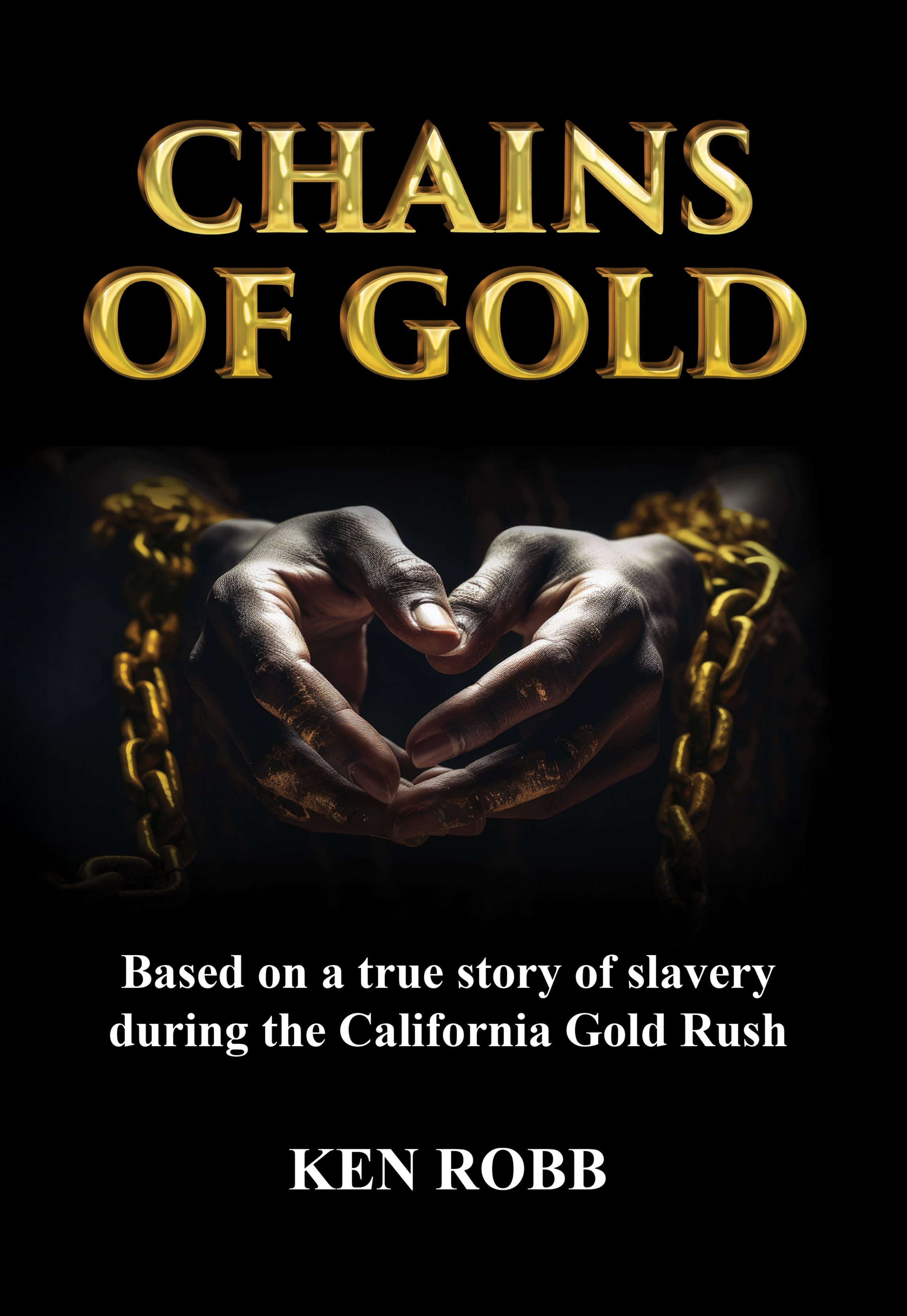
Title: Chains of Gold: Based on the True Story of Slavery During the California Gold Rush
Author:
Publisher: Word Star Ink
Genre: Historical Fiction, US Historical Fiction
Published: September 22, 2025
Pages: 438 pages
The year is 1852, and Carter is shouting his freedom into the face of the law as deputies close in, threatening to drag him back to Mississippi in chains. From this moment of terror, the story retreats a couple of years back to the Perkins Plantation, where Carter is not free at all but enslaved, under the watch of a brutal overseer. It is here that Charles Perkins returns home from college to witness the abuse of his slaves.
Although Carter and Charles are half-brothers, playing side by side as boys, adulthood exposes the lie of that intimacy. One is granted power by birth; the other is denied ownership of his own body. I was struck by how powerfully the author juxtaposes affection and oppression throughout the story, illustrating how love can coexist with, and be corrupted by, slavery. Carter and Charles’ bond is no match for a system designed to break one man for the comfort of another.
Charles Perkins is the oldest to inherit the plantation. He was gifted land and slaves, and his father wants his sons to learn how to manage a plantation. Despite this, Charles is noticeably different from his brother. Rather than basking in the excitement of running his own plantation, Charles shows more compassion, doesn’t want the enslaved to be mistreated, and has dreams of going to California to find gold.
Carter is an intelligent Black man. He knows how to read despite being enslaved (something he hides), pays attention to details (especially details on slavery), carries his Bible everywhere he goes, and watches Charles’ back. He is more responsible and proves to be his brother’s keeper on more than one occasion.
While Carter yearns for true freedom, Charles is a man of his time. Despite how much grace he extends, he is still a slave master. As Charles reminisces about the beauty of the mansion and the land, recalling his father’s ambition and how hard their ancestors worked to farm and buy the land, Carter reminds him that “more land means more slaves.” He knows it was built with his family’s blood, sweat, and tears. (Robb 2025)
Though looking at the same view, the men see two different worlds. This is reflected throughout the story. While Charles’s love interest, Emmy, gives him a professional photo to remember her by, Carter’s love interest, Peg, gives him a charcoal drawing she made using a mirror.
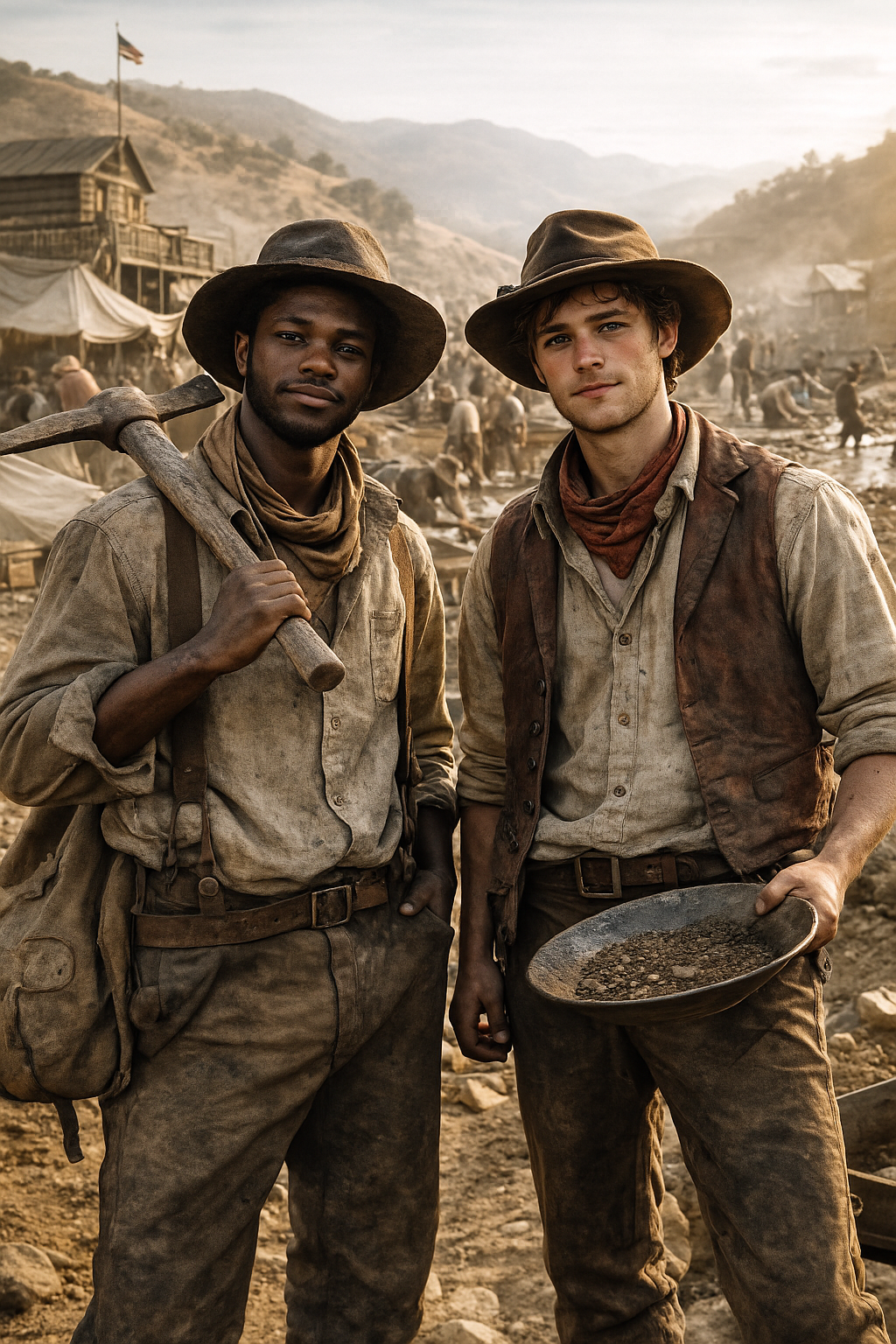
The narrative eventually follows Carter and Charles westward to California in pursuit of gold, a journey the author renders with careful attention to historical details. Rather than functioning solely as an adventure, the passage underscores the persistence of racial and social hierarchies across geographic space. In California, distance from the plantation does not translate into liberation from inherited roles. Charles’s attempts at fairness are marked by visible moral ambivalence, yet the surrounding society repeatedly reasserts the boundaries between them.
This tension is crystallized in several figures throughout the book, such as Bill, the seasoned miner, whose disapproval when Carter refers to Charles as his “master” exposes the unspoken codes governing race, power, and language. This tension resurfaces in Charles’s exchange with Fritz, who asks whether Carter is paid.
Although Charles views himself as well-intentioned, his decision not to compensate Carter—and his quiet assurance that the money would not matter to him—reveals how deeply he remains anchored in the assumptions of mastery. In this moment, Charles acts not as an equal or a brother, but as a man still shaped by the privileges of ownership.
The author does a good job of highlighting the lesser-known aspects of California’s history that are not widely taught.

Slavery and unfree labor were deeply ingrained during the Gold Rush era, despite California’s 1850 admission as a “free state” prohibiting slavery. Slaveholders brought enslaved Black people to work mines, and state laws like the 1852 Fugitive Slave Law enforced this practice. This resulted in complicated legal disputes, community resistance from free Black Californians, and the persistence of servitude until the Civil War.
The best thing about this book is that it’s based on a true story. Both the characters and the Gold Rush era are also well-researched, including the scene where Charles explains to the men how to transform the gold into banknotes. We often overlook the fact that paper money was once backed by gold, until the gold standard was removed in 1971 when Nixon ended the dollar’s convertibility to gold. This is why a dollar in 1800 had far more buying power than a dollar in 2025.
In 1850, $1 could buy what about $40 buys now.
This is a long book, so it will take some time to read. However, if you are looking for some good historical fiction, this one is well worth the time! I was eager to see what would become of the characters.
I think you will too.

Ratings
- Plot Movement / Strength: 4/5
- Entertainment Factor: 4/5
- Characterization: 5/5
- Authenticity / Believable: 5/5
- Thought Provoking: 5/5
Overall: 5/5
Chains of Gold is Available On Amazon Here!
The Review Registry is Closed for 2025.
To Be Added to the Waitlist for 2026, please email the first chapter of your book to the email listed in our review policy with “Book Review Waitlist” in the subject line. While this does not guarantee a review, it places your book at the top of the list for consideration in the new year.
To apply for 2026, click here

Yecheilyah’s Book Reviews is a reputable review service that features writers from around the world, including both traditionally and self-published authors. We are listed on Kindlepreneur as a top-tier book review blog and on Reedsy as one of their vetted active book blogs that provide insightful, excellent book reviews.
*Books are read in the order they are booked.



 The PBS Blog