Black History Fun Fact Friday – William Still

Welcome back to Black History Fun Fact Friday. Today, as promised, we are looking at the life of William Still.

Since it’s been a busy week, I did not actually get to write an article. I usually stay up late to draft these but I couldn’t do three articles last night. So, I am posting a brief biography of Still’s life from the National Underground Railroad Freedom Center which you can find at the source below.

Source: http://freedomcenter.org/content/william-still

“William Still was born in Burlington County, New Jersey. His father, Levin Steel, had been enslaved, purchased his own freedom, and changed his name to Still to protect his wife, Sidney. Mrs. Still had tried to escape once before she succeeded, but could only bring two of her children with her. William Still had little formal education but studied whenever he could. In 1844, William moved to Philadelphia.

In 1847, he found a job as a clerk and janitor for the Pennsylvania Society for the Abolition of Slavery. He soon began aiding fugitive slaves, often sheltering them until they could find their way farther north. One fugitive was his older brother, Peter, who had been left behind when his mother escaped forty years earlier. These experiences led William to save careful records about the people he helped. Meanwhile, Still purchased real estate, opened a store selling stoves, and later founded a successful coal business.

Before the Civil War Still had destroyed many of his records about aiding fugitives, because he feared they would be used to prosecute people. After the war, his children persuaded him to write the story of his exploits and the people he helped. Still’s book, The Underground Railroad (1872), is one of the most important historical records we have. Although Still recognized the many contributions of white abolitionists, he portrayed the fugitives as courageous individuals who struggled for their own freedom. Still proudly exhibited his book at the Philadelphia Centennial Exposition in 1876.”

Source: http://freedomcenter.org/content/william-still

HBO Releases Full Trailer for ‘The Immortal Life of Henrietta Lacks’

I read the book a couple years ago and wrote a Black History Fun Fact about it (that you can find under the Black History Fun Fact page on the sidebar) I heard then Oprah was making a movie about it. Looks like its about to come out. Thanks Nikki for sharing.

nikki skies's avatarNikki Skies

HBO wants you to add another must-see film to your list:The Immortal Life of Henrietta Lacks.The film, which is produced by and stars media…

Source: HBO Releases Full Trailer for ‘The Immortal Life of Henrietta Lacks’

View original post

Black History Fun Fact Friday – UNDERGROUND TV Show

Since the TV show I want to feature today as part of our “Movie” Night Friday was Underground anyway, I decided to combine it with Black History Fun Fact Friday since it is on the same lines.

Today, we are discussing Underground, one of the most powerful TV shows on right now. (One of the deepest movies is GET OUT. You must check into it if you have not gone to see it).

First, let’s catch you up:

Wikipedia: About Underground

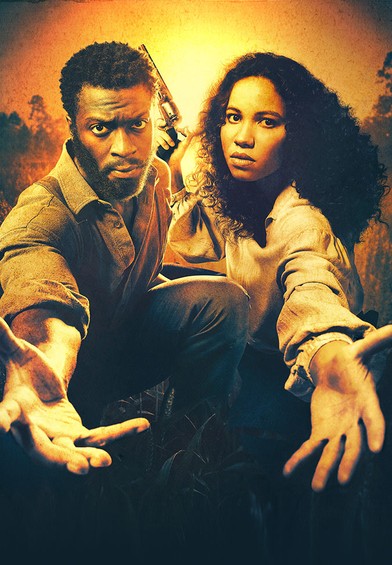
5f1ef4a0-ea56-11e6-9a77-028878e65d97_thumb_gallery_large
Photo Credit: WGN America – Underground

“Driven by the dreams of a courageous blacksmith named Noah, some plantation slaves in 1850s Georgia band together to attempt a daring escape. The fight for their lives, their futures and their freedom leads to Noah’s risk-filled plan to travel hundreds of miles away via the Underground Railroad. The landmark 10-episode anthology is created by Misha Green (“Sons of Anarchy”) and Joe Pokaski (“Daredevil”) and co-executive produced by John Legend, who also oversees the series’ score, soundtrack and musical elements.”

Trailer of Season One:

We are now in Season Two and it is already off to a blood racing start. One of the reasons I love this show is because it is well-written, something that does not happen often on television. What I mean by well-written is that the history is accurate. While there are plenty of sad parts (as slavery was not pretty) it is well balanced with factual information. The creators (and actors) of this show didn’t just throw something together. They did their research.

Who Ran the Railroad – The Underground Railroad is often portrayed as being ran mostly by white abolitionists with lots of people. While white abolitionists and Quakers surely helped, a lot of the people running the show were free blacks from the North too and I love how the program shows this (though subtly) by having Rosalee and the others front and center of the operation and not in the background just being “carried” by the helping whites. “…very few people, relatively speaking, engaged in its activities. After all, it was illegal to assist slaves escaping to their freedom. Violating the 1850 Act could lead to charges of “constructive treason.” Being an abolitionist or a conductor on the Underground Railroad, the historian Donald Yacovone related in an email to me, “was about as popular and as dangerous as being a member of the Communist Party in 1955.”

– Henry Louis Gates Jr.

The most noted black man who helped to run The Underground Railroad is William Still who operated with the assistance of white abolitionists. William Still, a free-born Black, became an abolitionist movement leader and writer and was also one of the most successful Black businessmen in the history of the City of Philadelphia. Next week, I’ll do a Black History Fun Fact on him with more details.

3e146928-ea80-11e6-959e-028878e65d97_cast_crew_detail_large

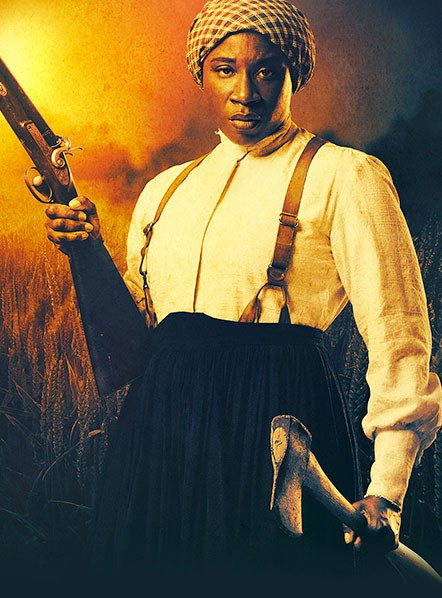
Humanizing Harriet Tubman – Another thing I see is that the writers and directors of Underground humanizes Harriet Tubman. As much as we complain about too many “slave stories” we really don’t know as much about slavery as we think we do, first because we weren’t there and second because we don’t study history. All we really know about Harriet are the quotes we read but in this show she is brought to life and has feelings. She is brave but also fearful. She is fierce but also concerned. She’s a warrior but still a woman; a gentle mother-like figure to Rosalee (The Black Rose) as she takes her under her wing. One of the ways to which Harriet is humanized in addition to these emotions is the calling of her by her nickname: Moses.

Female Moses – Also, called “General Tubman” people began to call Harriet Tubman Moses because of her leading her people out of slavery like Moses led the children of Israel out of Egypt. The powerful thing about this to me is that we are the same people. There is countless evidence of the physical appearance of the ancient Israelites but not just the physical appearance but also the culture of the people. After the destruction of Jerusalem in 70 c.e. by the Roman Emperor Titus and his general Vespasian, we fled into East Africa (Ethiopia, Egypt, the Sudan, etc.) and from there migrated to other parts of the African continent, widely settling on the West Coast to the extent that some tribal African nations still observe Hebrew customs and traditions. Tribes such as the Yoruba, Congo, and Ashanti can still be found keeping laws that can also be found in the Old Testament.

Upon The Transatlantic Slave Trade and our enslavement in the U.S. and pretty much everywhere else (we did not just come into America but were spread across the four corners) we sang many songs (spirituals) that told the history of who we were as a people before slavery. These songs, like “Go down Moses” and “Wade in the Water” (for which a lyric is, “Who’s that dressed in white, must be the Israelites”) was not just the symbolism of a spiritual people but the history of a people who lived the lyrics. Thus, Harriet’s nickname is powerful not just because her leadership in freeing her people from America is symbolic of Moses freeing us from Egypt, but also because she is his ancestor. In the words of Malcolm X, “You are the people of the book. You are the lost sheep.”

Harriet Tubman’s Spells – Speaking of Moses, I was excited to see that they put this in the show because it is a fact we don’t hear often. Harriet Tubman suffered from severe headaches, and seizures. She also had a form of narcolepsy where she would fall asleep without notice. Her condition caused her to have visions believed to have helped her in her missions. They showed this in Wednesday’s episode when she fell asleep at the table.

59106d56-efdc-11e6-959e-028878e65d97_photo_gallery_large

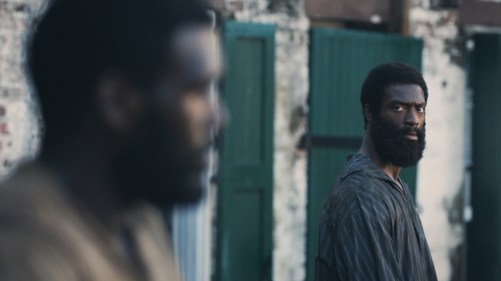
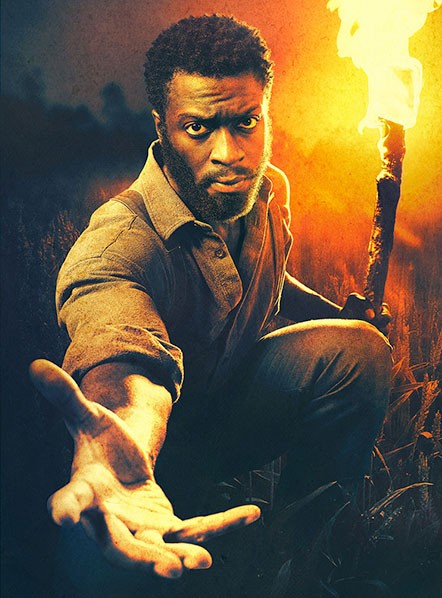
Aldis Hodge as “Noah”

Full Beards – I love the full beards and the masculine image of the black man. It was a subtle thing but present. I imagine Moses, David, or Gideon wore beards like that. Nonetheless, this is how men grew their beards back then, very thick and covering the whole lower face. Sometimes you couldn’t even see their mouths.

4039c3e4-ea79-11e6-9a77-028878e65d97_cast_crew_detail_large
Photo Credit: WGN America: Underground

Slave Examinations / NFL Combine Evaluations – Speaking of black men, they showed you how enslaved blacks were inspected when they were looking at Noah’s teeth and body when he was in jail. (Speaking of jail, such physical examinations also happen there.) Enslaved blacks were naked and examined before they were bought to show potential buyers that they were of good stock and to determine how useful that person would be based on age, size and health. With the NFL combine, evaluators try to project the player’s longevity. Players strip down to bare minimums to have their bodies pricked and prodded for size and strength in an eerily similar way as their ancestors were pricked and prodded by slave buyers. The more they can get out of a player, the better. Enslaved Blacks worth was similarly judged by what the plantation owners believed they could get out of the enslaved long term.

Moss on the Tree – Another subtly, it is a testament to the story’s attention to historic detail. As Noah is trying to escape his captors, he notices the moss on the tree. This told him which direction he was going because there’s a tendency for moss to grow on the north side of the tree in the Northern Hemisphere.

Sweet-grass Baskets – The baskets the women carried on their heads are sweet-grass baskets, one of the oldest handcrafts of African origin used to separate the rice seed from its chaff. Speaking of women, we didn’t even talk about how fearless they were. I loved the part when Elizabeth thought they were going to pull out sewing items but they pulled out guns but I will stop here.

I hope I’ve sparked enough curiosity for you to go ahead and watch the show! Or at the very least get some young people you know to watch it as a History lesson. It airs every Wednesday @ 9:00a CST on WGN. (No one paid me to say this. Maybe I should ask for a check).

Underground Season Two Trailer

Black History Fun Fact Friday – Seneca Village

Got a short fun fact article for you today.

I love finding the hidden treasure of black communities that existed and thrived that we’ll never know about (until we look). I’ve mentioned several of such communities on this blog in the past and here’s another one.

Seneca Village was settled in the 1820s on the eve of Emancipation in New York. The only community of black property in the city at the time, it was located between 82nd and 87th Street east of what is Central Park today.

lvseneca18n

The Village was a thriving community of blacks (two-thirds) and whites started to settle there as well. The community had its own school and a population of over 250 people. Houses were also built on the land, some of them elaborate two-story with barns and others a bit more modest. This was an achievement because New York, like the rest of the country, was a place of slave-ownership. Contrary to what you’ll learn in school, the South was not the only place to find blacks who were enslaved but many northern cities did as well. In 1703, more than 42 percent of New York City households held slaves and slavery was a key institution in the development of New York. According to The New York Historical Society:

“As many as 20 percent of colonial New Yorkers were enslaved Africans. First Dutch and then English merchants built the city’s local economy largely around supplying ships for the trade in slaves and in what slaves produced – sugar, tobacco, indigo, coffee, chocolate, and ultimately, cotton. New York ship captains and merchants bought and sold slaves along the coast of Africa and in the taverns of their own city. Almost every businessman in 18th-century New York had a stake, at one time or another, in the traffic in human beings. During the colonial period, 41 percent of the city’s households had slaves, compared to 6 percent in Philadelphia and 2 percent in Boston. Only Charleston, South Carolina, rivaled New York in the extent to which slavery penetrated everyday life. To be sure, each slaveholding New Yorker usually owned only one or two persons.”

The only difference between Southern and Northern slavery was that instead of plantations, slaves in the North slept in cellars and attics or above farmhouse kitchens in the country. Nonetheless, the enslaved population of the city was emancipated in 1827 and many of these freedmen comprised the residents of Seneca Village.

The Village’s demise came with the building of what is now Central Park. The government claimed the land under the right of eminent domain and evicted the residents. Since then, Seneca Village has been pretty much forgotten in history. Well, until now.

_____________________________

Don’t forget, you can find all the Black History Fun Fact Articles

under the Black History Fun Fact page in the sidebar.

We are already 17 weeks in since the re-launch of this segment last October. Wow!

Black History Fun Fact Friday – Meta Vaux Warrick Fuller

black-history1

Welcome back to Black History Fun Fact Friday.

Today I introduce to you Meta Vaux Warrick Fuller, the first black woman to receive a federal commission for her art. Fuller’s artwork became the precursor to the resurgence of African themes in art seen during the Harlem Renaissance Movement. Not only a time of Jazz, Literature, and Flapper women, this explosion of black artistic culture also included artwork which is not discussed as much as let’s say the literature and the music.

fuller_meta

Born in Philadelphia in 1877, Fuller was the youngest of three children born to William and Emma Warrick. Prominent hair stylists who owned a flourishing Philadelphia store, Fuller’s father was a prosperous barber and the owner of several shops. Her mother was a hairdresser with wealthy white clients who were served in the family’s shop. The family also took vacations to the same places as did their upper-class white Philadelphian clients and lived in a three-story house. Why is it then that Fuller’s name is different from her parents?

Meta was named after one of these clients, Meta Vaux, the daughter of a Senator Richard Vaux. It makes me think about many blacks during the time and whether or not we felt we needed to assimilate into white society in order to fit into the culture of America. For instance, both W.E.B. Dubois and Meta (who was close with Dubois) felt that blacks were capable of the highest achievements but also that this meant to be educated as whites were educated. In addition, despite eventually producing “African” themed art, Meta rejected DuBois initial suggestion that she concentrate on African-American themes when they first met in Europe.

While Meta was successful and is highlighted here as an unfamiliar face, a precursor if you will to The Harlem Renaissance, the movement itself was not all rainbows and whistles. While the artistic explosion is something I love (being a poet and all) I hate that some blacks (as talented as we are) felt at the time that they needed to fit in with White America in order to make it, a truth not everyone is willing to acknowledge but this is Black History Fun Fact Friday so we must keep it real. As Carl Van Vechten titled his book, for many blacks Harlem was, at the time, “Nigger Heaven”.

1-2-227-25-explorepahistory-a0a8l1-a_349
Fuller’s Work: Ethiopia Awakened

Nonetheless, in October of 1889, Fuller arrived in Paris where for the next three years she would study with prominent French sculptors which would have a major impact on her work. While in Europe this is where she would encounter Dubois for the second time and it was the beginning of a friendship that continued for many years. Dubois and Thomas Calloway was organizing a Negro exhibit for the Paris Exposition and visited Meta’s studio to her surprise.

When Meta returned to the States, she established a studio in Philadelphia where art organizations flourished and in the early 1900s through the twenties she continued to do well. In 1928, she was selected to show her work at The Pennsylvania Academy of Fine Arts.

In 1909 she did a 15-piece work for The Jamestown Tercentennial Ex­position illustrating black’s progress in America since the Jamestown settlement. Fuller also received a gold medal for “The Jamestown Tab­leau,” and this  established her reputation as an artist and began a long and committed career. Despite my personal feelings, it is refreshing to study the faces of some of the unknown artists of this most important time in history.

Black History Fun Fact Friday – Black Land Ownership

black-history1

Welcome back to Black History Fun Fact Friday where Black History Month is never over! BHFFF is coming to you every Friday where I strive to introduce to you lesser known faces and lesser known facts. Today, we are talking Black Land Ownership, the most underrated , least discussed black business yet.


Land ownership has always been important to African Americans, although we own less than 1% of rural land in the United States today, it has not always been this way.

At one point, Black Land Ownership was at its peak (the 1910s – 20s) and helped to start such communities as The Mound Bayou in Mississippi, Rosewood in Florida, Blackdom in Albuquerque New Mexico, and, Black Wall Street in Oklahoma and many, many more. (See 7 Black Communities that Prospered) “In the 50 years following the Emancipation Proclamation, African Americans held over 15 million acres of land. Today, African Americans own less than 7 million acres of land. In 1920, African Americans owned 14% of all farms. Today, African Americans own less than 1% of all farms.” (Vivian M. Lucas, Barren: The Decline of African American Land Ownership from 15 million to 7million acres).

In Roll of Thunder Hear My Cry, the book that opened me up to the world of Black Literature as a child, Mildred D. Taylor starts a slew of books centered around the Logan family and their fight to keep their land. Land, always that place families could come back to, where gatherings could be held and where communities could root themselves. In Forty-Acres, Phyllis R. Dixon centers her story around black landownership. Rising from a sharecropper’s son to the largest Black Landowner in Dwight Count, Arkansas, C.W. Washington’s stroke forces him to retire from farming and he must decide what happens to the land. And finally, In Queen Sugar, by Natalie Baszile, now a TV show executive produced by Oprah, it again brings to light the subject of black landownership when Charley Bordelon inherits her father’s eight hundred acres of sugarcane land.

Unlike today, where paper money is valued above anything else, land ownership had always been praised as a vital contributor to financial and economic stability for the African American community. Landowners could build houses on the land, raise animals on land and grow food. We sold food we grew, bartered among neighbors, had bountiful dinners and when The Great Depression hit, many southern black land-owners didn’t notice until years in. Land ownership was something cherished, something we could call our own, and something to which we could be proud of.

What happened to families like the ones we read about and have grown to love? Where did Big Mama go and the land with her? What happen to Black Land Ownership and why was it so important to the people who came before us?

“Comparing the U.S. Agriculture Census data on African-American farmland ownership for 1910 and 1997, it shows a drastic decline from its peak of 15 million acres in 1910 to 2.4 million acres in 1997.  A recent study estimated that in the early 20th century, rural landownership among African-American farmers and non-farmers was between 16 and 19 million acres (Gilbert, J., 2002).  The 1999 Agricultural Economics and Land Ownership Survey (AELOS), which assessed private rural landownership across race and use (i.e. farming, forestry, etc.), found that there are currently 68,000 African-American rural landowners and they own a total of approximately 7.7 million acres of land, less than 1% of all privately owned rural land in the United States.  (AELOS, 1999).  Sixty percent (60%) of which is owned by non-farmers.  (AELOS, 1999).  However, this acreage is valued at $14 billion.  (AELOS, 1999).”

-Miessha Thomas, Jerry Pennick & Heather Gray, Federation/LAF staff, 2004

There are many factors that play into why land has lost its prominence among blacks today:

  • Discrimination of Black Farmers
  • Little political and technical understanding of the business of farming on behalf of the farmers themselves
  • Poor land management
  • Movement of blacks from the South to the North, in which case many sold their land
  • Heir Property passed down to heirs who don’t really care about the land
  • Underappreciated of the business of farming by young people who equate it to slave labor
  • Landowners dying off without leaving Wills

When my husband and I lived on our cousins’ 40 acres, we loved it. The land I mean. The house wasn’t much to speak of, but oh the land! We lived there for five years of our lives and as a couple who is interested in acquiring land of our own we learned a lot.

Not only did many families leave their wealth (land) for better financial opportunities in the North (which many of them did not find), many blacks also did not leave Wills to their children and grandchildren. Known legally as Estate Planning, this is the process of arranging for the distribution and management of your estate after you die which, sadly, many black families fail to do. The generation just a few steps out of slavery more than likely cared very much about the land but if the children who will keep the land going do not care, then the land is lost. In most families, when the older generation dies off (and did not leave Wills to indicate who the land passed down to), the land then falls into the hands of the State who then controls who owns the land and how much of land they own. In the case, there was estate planning, the land may also become heir property.

Heir property is when the land is passed down to heirs according to the state or blood relative successors who are in place to inherit the land. The problem with this in the Black Community is that the land was typically passed down to family members who are not as interested in the land, who does not live in the state where the land is, who is only interested in the oil rights of the land (royalties given to landowners who have had their land drilled on for oil by the oil companies, which, taints the purity of the soil so many of these lands are no longer good for growing food), and who could care less about the land’s upkeep. Heirs also comprised of relatives who may not have known each other and will probably never know that the land exists.

Gary Grant, National President of the Black Farmers and Agriculturalist Association, a nonprofit organization created to respond to the issues and concerns of African American farmers in the U.S. and abroad, addresses the continued loss of African American farms:

“We are losing land and wealth that our parents, grandparents, and great-grandparents worked, fought, and died to acquire for us,” he says. “We owe our ancestral warriors a debt– We must help ourselves by ensuring that the next generation is ready to control the land.”

During our time on the land, from which we acquired dogs, chickens, a horse, and started two gardens, my husband and I had long petitioned our elderly cousins on what it will take for us to buy some of the lands. After all, this was family. However, the land is heir property that must first be passed down to certain individuals. Individuals  who do not live near the land, rarely check up on the land, and who do not have a connection to the land in a way that would compel them to live on the property. This is not unusual. Many landowners, especially young ones, are more interested in living in the city and in brick houses. Thus, the land becomes abandoned since lack of land management can quickly get out of hand and little by little, the land is lost.

Still, land ownership is still a big deal in the African American community. There are still many blacks who own land and much more who are stepping out there in the quest to secure acres of their own. Whether it’s an acre, five acres, or forty, I encourage the reestablishing of Black Land ownership, the education of farming and the motivation of our young people to truly understand what land has meant to us as a people—long before slavery we were a farming people—and what it means to us today.

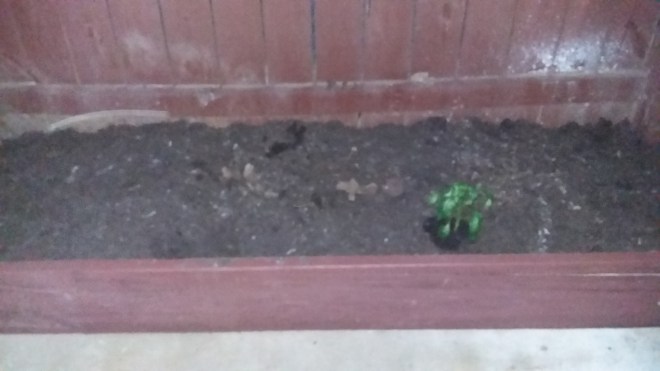
My husband and I are starting by growing our garden in the backyard. We may not have our acres yet but its a start! We’re growing Spinach, Onions, Tomatoes, Lettuce, Basil, Thyme, Rosemary, and Oregano.

20170223_235623

20170223_23563520170223_235618

20170223_235629

20170223_235603

Black History Fun Fact Friday – Twins or Nay?

black-history1

I’m not so sure we should call this a fun “Fact” Friday. It’s more like a Black History Fun Mystery Friday. Who wants to play? Get your magnifying glasses out, you’re gonna need them!

What if you were arrested and brought into jail, but upon entering were told that you had already been there? In fact, you were arrested before. “No I wasn’t,” you’d most likely say. The clerk will proceed to show you pictures of yourself. “Wow,” you think. “That’s my picture but I’ve never seen it before.”

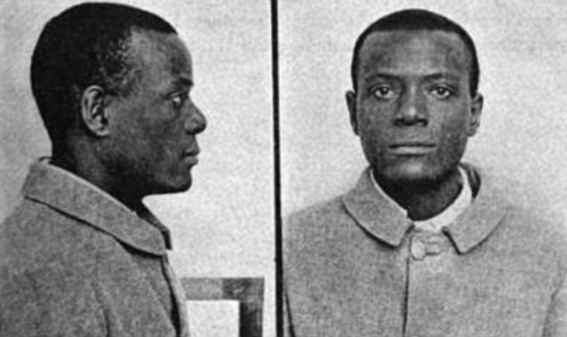
Will West
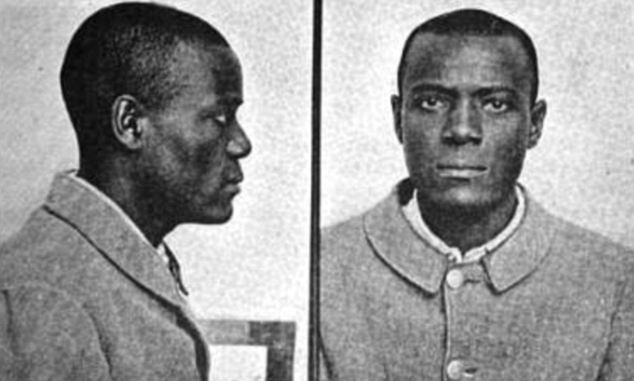
Mug Shot of Will West

That is what happened to Will West and William West. I admit this story is still controversial. Were they twins or not? I cannot say for sure myself. As a twin, naturally this story fascinates me. Was it a trick? Was it real? Did something supernatural take place? Maybe one man went back in time? Whatever happened, we have a real doppelganger situation on our hands (What’s a doppelganger? I take it you don’t watch Flash the TV show. A doppelganger is the version of you that exists in another timeline). I’m not joking. I think there really was something supernatural going on.

According to the story, Will West (or Will Tell, certain sources give different last names. Most of them use West so I will in this article) was arrested in 1903 and sent to the Leavenworth Penitentiary in Kansas. Back then they used a facial recognition system called The Bertillon System. The Bertillon System is a system developed by Alphonse Bertillon, a French criminologist who first developed the system of physical measurements of body parts, especially components of the head and face, to produce a detailed description of an individual. Invented in 1879, the system became known as the Bertillon system and gained acceptance as a reliable method of criminal investigation, though there were complaints that the system was flawed. The West case proved that it was in 1903 when two unrelated black men would inadvertently inspire the use of a different system, or at least that’s what is documented.

Will walked into Leavenworth in 1903 and caused the Clerk to double check his records. He was adamant that he’d seen this man before. In fact, not only did he see him before but it was two long years ago. Yes, he is sure of it. He had already arrested the man standing in front of him and his name was William West.

Using the Bertillon System would not help in this case, as the men had the same measurements and were identical in appearance. Let us imagine what the conversation was like. The clerk, whose name was McClaughty, pulls out Williams records, flips through them and looks up at Will. His mouth is twisted, his brow carving deep lines in his head. He looks away, staring at the files in front of him and then back up at Will.

“So, what you’re saying is that this ain’t you?”

The man turns the files around to show a photo of what looks to be the man in front of him.

article-1392418-0c55ce6e00000578-700_634x381
Mug shot of William

Will’s eyes buck but he shakes his head.

“No. I mean, that’s my picture but I don’t know where you got it from. I have never been here before.”

The Clerk did more searching and discovered that a William West was arrested two years ago for murder and that Will was a different person altogether. The incident caused the move from The Bertillon System to that of fingerprinting in criminal cases. Or at least the start of its use in the U.S. Fingerprinting had been used before in other parts of the world. According to Google: “The English first began using fingerprints in July of 1858, when Sir William James Herschel, Chief Magistrate of the Hooghly district in Jungipoor, India, first used fingerprints on native contracts. (By the way, Twins have different fingerprints)

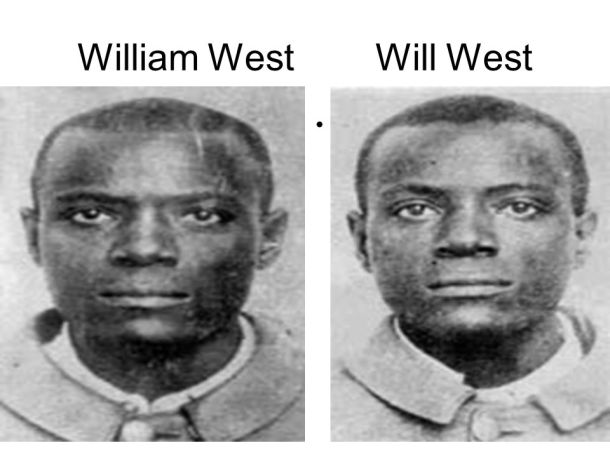
Here’s a side by side of Will and William:

slide_6

Some sources say that the men really were Twins. If this is true, why would Will lie about it? I mean, he was being arrested. What would be the motive behind the twin’s actions? Did they commit a crime together and one just got caught later?

If you scroll up to the first photo of Will and then back to the profile of William, their heads are shaped differently. William’s lump is more pronounced and there’s more of a curve. William’s profile also shows that his cheeks are slightly more sunken in, which isn’t so in the first image. This would indeed show flaws in the Bertillon System, which gave the men the same measurements (but you can look at the back of their heads and see they are shaped differently). William is also wearing more of a frown than Will is. According to the story, William was arrested for murder two years earlier. By the look on his face, he appears to have been incarcerated longer. I won’t say that he did it because we are talking about 1903 here ( a time where black men were often accused of a murder they did not commit), but he does look to be more agitated than Will.

Will’s image is also lighter and that’s either a mole or ink above his lips and under the nose. Either way, it’s not in William’s photo. Neither is what looks to be a scar on William’s head present in Will’s picture. There’s enough evidence physically to see these may, in fact, be two different people. One thing’s for sure, these men look too much alike not to be twins, but who knows? Maybe Will is from a different timeline altogether or the men really were not related. After all, the truth is stranger than fiction.


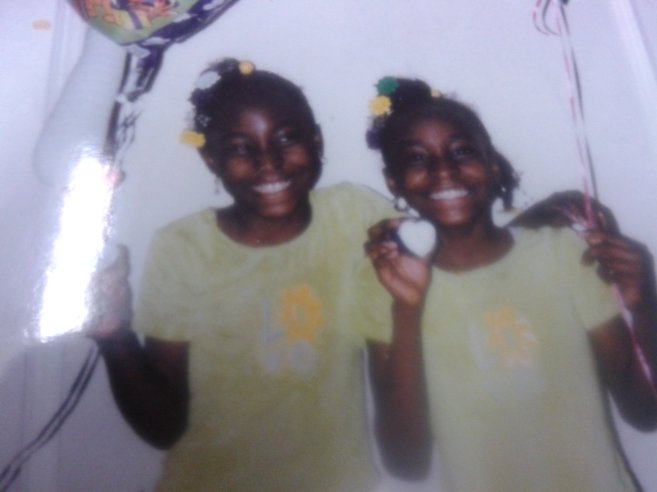
Here’s a throwback for fun by the way. This is Tracey and me turning ten. I can’t use a recent picture because then it’ll be obvious. I have locs and she doesn’t.

Can you solve the mystery? Where’s EC? (Lol hee hee)

120831_0003
Photo Source: Copyright©Yecheilyah Ysrayl. May, 1997