Yecheilyah’s Book Reviews – Crossroads: Women Coming of Age in Today’s Uganda Edited by Christopher Conte

Title: Crossroads: Women Coming of Age in Today’s Uganda

Editor: Christopher Conte

Print Length: 180 pages

Page Numbers Source ISBN: 1507680228

Publication Date: August 30, 2015

ASIN: B014QBPALM

Crossroads is a fascinating anthology comprising autobiographical essays by several Ugandan women. I loved the opportunity to learn more about the Ugandan culture, the upbringing of African women, and how it is different (and in many ways similar) to the upbringing of Black women here in America. Rarely do we hear of what these women endure so it was refreshing to read about it. All of the stories have a common coming-of-age theme where the women discuss their experiences coming into womanhood among the customs and traditions of their country. We learn about their childhoods, sex, marriage, career, and livelihood.

All of the stories were compelling, but a few really stuck out for me more than the others. I enjoyed the opening story, for instance, about the meaning of names and the cashier mistreating the woman because of her name. I can relate to having a unique name myself and I am often asked the same questions that Nakisanze Segawa was asked.

Two stories had the biggest impact on me above all the others. The young women taken from their University without a word, abused and forcibly imprisoned was heartbreaking. I also found the customs surrounding the Ssengas both fascinating and odd.

By custom Ssenga’s are paternal aunts who assume special responsibilities and help to guide the women, their “nieces” in the ways of society. They teach the women how to behave, submit to a man, how to display class and grace, they monitor their manners and their ways around the house.

Ssengas teach young women about their bodies, hygiene, and sex, preparing them to be good wives. I love the concept of having someone there to mentor young women and to ensure they grow to be respectable wives and mothers. The fact that the Ssengas take over this role and not the mother is interesting to me. I found myself wondering if it would help for young women in the States, especially young Black women without mothers, to have this kind of guidance and support instead of having to figure things out on their own or in the street.

I enjoyed least the extent to which the teachings of the Ssengas went. It’s one thing to teach young women about their bodies and how to be wives, but the extent to which these women are obligated to serve their husbands is, in my opinion, oppressive. Some of the behaviors were utterly offensive and unwarranted. I support the idea of submitting. I think that men are the spiritually appointed head of the home and that wives should submit to their husbands as the Bible commands.

However, I dislike how submission is abused, manipulated, and twisted to support abusive behavior. Not only do women in America have an inaccurate concept of submission but so do women in other countries. Submission is not slavery; a man’s authority over his wife does not exempt him from certain duties and responsibilities or allow him to be abusive. Men are to love their wives as their own bodies, and a wife supports and respects her husband.

If done properly, submission and authority can work well but if not done correctly, can easily become oppressive for both parties.

Some great qualities are promoted in Uganda that many women across the globe can benefit from, but there are some things that we may find strange if we didn’t grow up that way.

This book sparks great conversation about the lives of women and is relevant considering the social and political climate of our time.

In what way does earning degrees and having an education balance with being good wives? Do the women defy tradition or follow it?

Movement / Strength: 5/5

Entertainment Factor: 5 /5

Authenticity / Believable: 5/5

Thought Provoking: 5/5

Overall: 5/5

Crossroads: Women Coming of Age in Today’s Uganda is available now on Amazon


About the Editor

Christopher Conte is an American journalist who spent fifteen years as a reporter and editor for the Wall Street Journal before beginning a freelance career. He has traveled extensively throughout Africa, eastern Europe, and Asia, as a consultant for the World Bank’s International Finance Group. Conte has also worked as a trainer and mentor to journalists in Uganda, and other locations throughout Africa and Asia.
The First “African” Slaves Arrive in Jamestown, Virginia, Aug. 20, 1619

Screenshot_2017-08-19-20-44-48-1
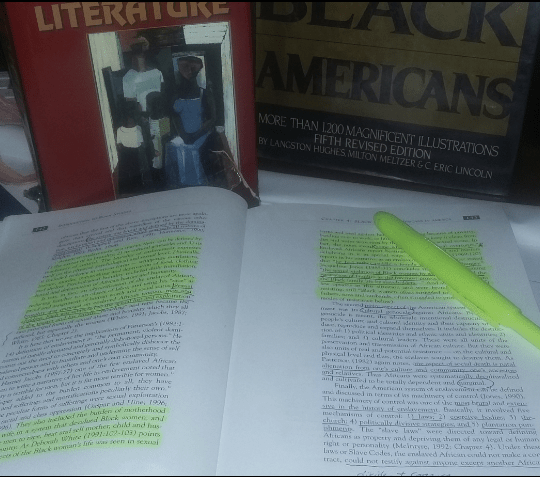
My messy desk…studying my history

“A Dutch ship carrying 20 Africans arrived in Jamestown, Virginia, on Aug. 20, 1619, a voyage that would mark the beginning of slavery in the American colonies. The number of slaves continued to grow between the 17th and 18th centuries, as slave labor was used to help fuel the growing tobacco and cotton industries in the southern states. At the end of the Civil War in 1865, some 4 million slaves were set free. However, racial inequalities and violence toward newly freed slaves would persist in the country throughout the 1860s and 1870s.”

– Source, BET National News

“The arrival of the “20 and odd” African captives aboard a Dutch “man of war” ship on this day (August 20) in the year 1619 historically marks the early planting of the seeds of the American slave trade.” (Benjamin Banneker also challenged Slavery In Letter On This Day In 1791)

Source, Ioned Chandler, Newsone

“Today in 1619, it was reported by English tobacco farmer John Rolfe, husband of famed Indian princess Pocahontas, that “20 and odd” African slaves arrived at the Jamestown Settlement in British colonial North America aboard a Dutch man-of-war ship. The ship had originated in the Portuguese colonies of present-day Angola, which had been established in the 1500s. Angola was a heavy exporter of slaves to Brazil and the Spanish colonies.”

Source, Infobox

“Newly established English colonies in North America create a demand for laborers in the New World. At first, captured Africans are brought to the colonies as indentured servants. Once their term (3-7 years) is completed, indentured servants are allowed to live free, own land, and have indentured servants of their own. However, this system does not last long; indentured servitude gives way to lifetime slavery for Africans as the British colonies grow and the need for a permanent, inexpensive labor force increases”

Source, This Far by faith

“The Black Atlantic explores the truly global experiences that created the African American people. Beginning a full century before the first documented “20-and-odd” slaves arrived at Jamestown, Virginia, the episode portrays the earliest Africans, both slave and free, who arrived on the North American shores. Soon afterwards, the Trans-Atlantic slave trade would become a vast empire connecting three continents. Through stories of individuals caught in its web, like a 10-year-old girl named Priscilla who was transported from Sierra Leone to South Carolina in the mid-18th century, we trace the emergence of plantation slavery in the American South. The late 18th century saw a global explosion of freedom movements, and The Black Atlantic examines what that Era of Revolutions—American, French and Haitian—would mean for African Americans, and for slavery in America.”

Source, The Black Atlantic, episode one of The African Americans: Many Rivers to Cross with Henry Louis Gates, Jr., 

“In terms of African involvement, it is true also that Africans enslaved others before the coming and demands of the European. But three other facts must be added to this statement to give a holistic picture.. African enslavement was in no way like European enslavement. It was servitude which usually occurred “through conquest, capture in war or punishment for a crime” (Davidson, 1968:181). It could also resemble serfdom as in Medieval Europe where peasants were tied to the land and a lord for protection. They often lived as members of the family, married their masters daughters and rose to political and economic prominence and did not face the brutality and dehumanization which defined European chattel slavery.”

Source, Introduction to Black Studies, Ch. 4: The Holocaust of Enslavement

Black History Fun Fact Friday – Meta Vaux Warrick Fuller

black-history1

Welcome back to Black History Fun Fact Friday.

Today I introduce to you Meta Vaux Warrick Fuller, the first black woman to receive a federal commission for her art. Fuller’s artwork became the precursor to the resurgence of African themes in art seen during the Harlem Renaissance Movement. Not only a time of Jazz, Literature, and Flapper women, this explosion of black artistic culture also included artwork which is not discussed as much as let’s say the literature and the music.

fuller_meta

Born in Philadelphia in 1877, Fuller was the youngest of three children born to William and Emma Warrick. Prominent hair stylists who owned a flourishing Philadelphia store, Fuller’s father was a prosperous barber and the owner of several shops. Her mother was a hairdresser with wealthy white clients who were served in the family’s shop. The family also took vacations to the same places as did their upper-class white Philadelphian clients and lived in a three-story house. Why is it then that Fuller’s name is different from her parents?

Meta was named after one of these clients, Meta Vaux, the daughter of a Senator Richard Vaux. It makes me think about many blacks during the time and whether or not we felt we needed to assimilate into white society in order to fit into the culture of America. For instance, both W.E.B. Dubois and Meta (who was close with Dubois) felt that blacks were capable of the highest achievements but also that this meant to be educated as whites were educated. In addition, despite eventually producing “African” themed art, Meta rejected DuBois initial suggestion that she concentrate on African-American themes when they first met in Europe.

While Meta was successful and is highlighted here as an unfamiliar face, a precursor if you will to The Harlem Renaissance, the movement itself was not all rainbows and whistles. While the artistic explosion is something I love (being a poet and all) I hate that some blacks (as talented as we are) felt at the time that they needed to fit in with White America in order to make it, a truth not everyone is willing to acknowledge but this is Black History Fun Fact Friday so we must keep it real. As Carl Van Vechten titled his book, for many blacks Harlem was, at the time, “Nigger Heaven”.

1-2-227-25-explorepahistory-a0a8l1-a_349
Fuller’s Work: Ethiopia Awakened

Nonetheless, in October of 1889, Fuller arrived in Paris where for the next three years she would study with prominent French sculptors which would have a major impact on her work. While in Europe this is where she would encounter Dubois for the second time and it was the beginning of a friendship that continued for many years. Dubois and Thomas Calloway was organizing a Negro exhibit for the Paris Exposition and visited Meta’s studio to her surprise.

When Meta returned to the States, she established a studio in Philadelphia where art organizations flourished and in the early 1900s through the twenties she continued to do well. In 1928, she was selected to show her work at The Pennsylvania Academy of Fine Arts.

In 1909 she did a 15-piece work for The Jamestown Tercentennial Ex­position illustrating black’s progress in America since the Jamestown settlement. Fuller also received a gold medal for “The Jamestown Tab­leau,” and this  established her reputation as an artist and began a long and committed career. Despite my personal feelings, it is refreshing to study the faces of some of the unknown artists of this most important time in history.